| Key Facts | Detail |
|---|---|
| UNESCO World Heritage Sites: 52 (including 7 for outstanding architecture) | |
| Key contributions: Gothic architecture, Beaux-Arts classicism, Art Nouveau, Art Deco, Modernism | |
| Iconic architects: Viollet-le-Duc, Haussmann, Gustave Eiffel, Le Corbusier, Jean Nouvel | |
| Defining building types: Cathedral, château, hôtel particulier (private mansion), immeuble haussmannien (Haussmann apartment building) |

France has contributed more to the history of architecture than any country in Europe. The Gothic cathedral was invented here. The formal garden was perfected here. The modern apartment building, the Beaux-Arts museum, the Art Nouveau métro entrance, and the glass-and-steel tower were all French innovations. From the Pont du Gard to the Fondation Louis Vuitton, French architecture spans two millennia of ambition, style, and structural daring.
Roman and Romanesque (1st–12th Century)
Southern France preserves some of the finest Roman architecture outside Italy. The Maison Carrée in Nîmes is the best-preserved Roman temple in the world. The amphitheatres at Nîmes and Arles still host events. The Pont du Gard is the tallest surviving Roman aqueduct.
The Romanesque period (10th–12th centuries) produced massive stone churches with barrel vaults, thick walls, and semicircular arches. The pilgrimage churches along the road to Santiago de Compostela — Conques, Toulouse, Vézelay — are Romanesque masterpieces, their tympana carved with demons and saints in limestone that has survived nine centuries.
Gothic (12th–16th Century)
France invented Gothic architecture. The transition happened in one building: the Basilique Saint-Denis, just north of Paris, where Abbot Suger rebuilt the east end (1135–1144) with pointed arches, ribbed vaults, and large stained-glass windows that flooded the interior with coloured light. Suger described his goal as creating an architecture of divine illumination — walls of glass replacing walls of stone.
The French Gothic spread across northern Europe within a generation. The great cathedrals followed in rapid succession: Chartres (1194), Reims (1211), Amiens (1220), Beauvais (begun 1225, the vault collapsed twice — ambition exceeding engineering). Notre-Dame de Paris (begun 1163) predates them all and defined the genre.
The key innovations were French:
- Ribbed vaults — distributing weight along lines rather than across surfaces
- Flying buttresses — external arches that transferred the vault's lateral thrust away from the walls
- Rose windows — the great circular stained-glass compositions at Chartres and Notre-Dame
Renaissance and Classical (16th–18th Century)
François I imported Italian Renaissance style to France, beginning at the Loire Valley châteaux — Chambord, Chenonceau, Azay-le-Rideau — where Italian symmetry, pilasters, and loggias were grafted onto French medieval forms.
Classical architecture reached its apotheosis at Versailles (1661–1715), where Louis XIV and his architects Louis Le Vau, Jules Hardouin-Mansart, and landscape architect André Le Nôtre created the most ambitious palace complex in European history — 721,000 square metres of building, 800 hectares of gardens, and a political statement that subordinated all of France to a single geometric vision centred on the Sun King's bedroom.
Haussmann's Paris (1853–1870)
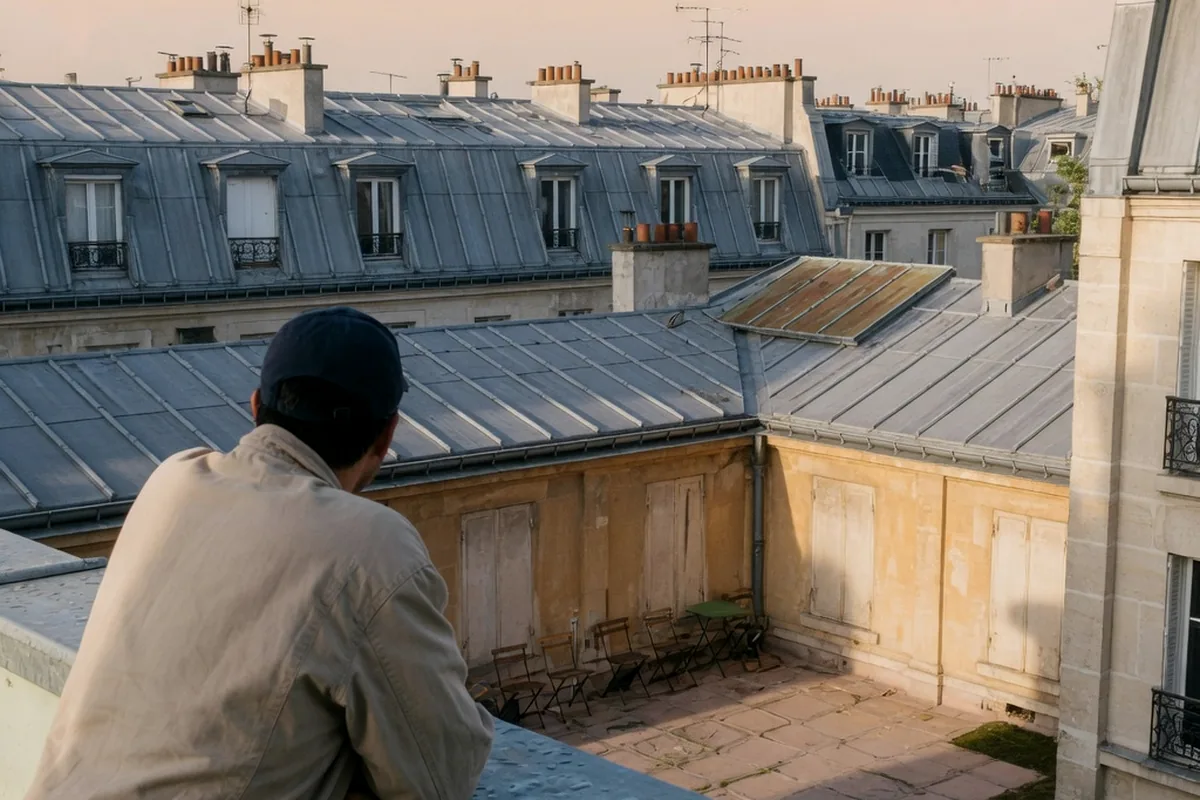
Baron Georges-Eugène Haussmann's reconstruction of Paris under Napoleon III was the most radical urban transformation in modern European history. He demolished medieval streets, created the grand boulevards, standardised building heights and façade materials (pale limestone, zinc roofs, wrought-iron balconies), and built the immeubles haussmanniens (Haussmann apartment buildings) that define Paris's visual identity today. The five-to-seven-storey stone buildings with their continuous balconies at the second and fifth floors create the rhythmic streetscapes that make Paris the most architecturally coherent major city in the world.
Art Nouveau and Art Deco (1890–1940)
Hector Guimard's Métro entrances (1900–1912) — cast-iron plant forms in sinuous organic curves — are the most visible Art Nouveau works in France. The movement flourished in Nancy (the Nancy School), where Émile Gallé and the Daum brothers created glass, furniture, and ironwork inspired by natural forms.
Art Deco crystallised at the 1925 Exposition internationale des arts décoratifs (International Exhibition of Decorative Arts) in Paris (from which the style takes its name). The Palais de Chaillot, the Théâtre des Champs-Élysées, and countless Parisian apartment buildings display the geometric elegance and luxurious materials of the style.
Modernism and Contemporary (20th–21st Century)
Le Corbusier (Charles-Édouard Jeanneret, 1887–1965) is the most influential architect of the twentieth century. His five points of modern architecture — pilotis, free plan, free façade, ribbon windows, roof garden — defined the International Style. His chapel at Ronchamp, the Unité d'Habitation in Marseille, and the Villa Savoye near Paris are all UNESCO World Heritage Sites.
Contemporary French architecture is among the most ambitious in the world. Notable works include Jean Nouvel's Institut du Monde Arabe and Musée du Quai Branly in Paris, Christian de Portzamparc's Cité de la Musique, Dominique Perrault's Bibliothèque nationale, and Frank Gehry's Fondation Louis Vuitton.
On the ground
| Pin | Working note |
|---|---|
| Page | French Architecture |
| Desk | L'Esprit |
| First use | Read the pins, then one related page — not five |
| Confirm | Official site or ticket desk the week you go |
French Architecture is a working page on L'Esprit, not a souvenir. Use it with the week you travel. French Architecture sits in a country that is easy to over-plan and easy to under-prepare. The arts layer is where visitors collect names. This page is the opposite: what to do first, what to skip, and which sibling guide holds the rest.
France rewards a slow unit. One arrondissement, one valley, one appellation, one park trail. The photograph of five landmarks in five days is a real holiday, and it is also a queue with a passport. If you only have three nights, spend two of them in the same bed. The third night is for a train, not a third hotel.
Working a visit
Practical France is sockets (Type E/F, 230 V), tap water that is safe, pharmacies that are the real clinic for minor trouble, and a lunch hour that still closes a village. Cards work in cities. Cash still opens some park kiosks, some island boats, and some market stalls that have never seen contactless. A lightweight adapter belongs in the personal item, not the hold.
We will not write as if every reader is on a gap year, or as if every reader is in a palace hotel. We will not flatten 'the south' into one climate. We will not treat a strike day, a jour férié, or a Tuesday museum closure as a personality quirk of the French. They are calendars. Check them. Then use French Architecture as a pin, not as scripture.
Cross the five guides instead of cloning them. La Porte holds trains and the first week. La Terre holds weather and park gates. L'Esprit holds museum Tuesdays and the Revolution. La Table holds the market morning and the wine list. Le Moteur holds the Tour, the working week, and why August is empty in Paris and full on the coast.