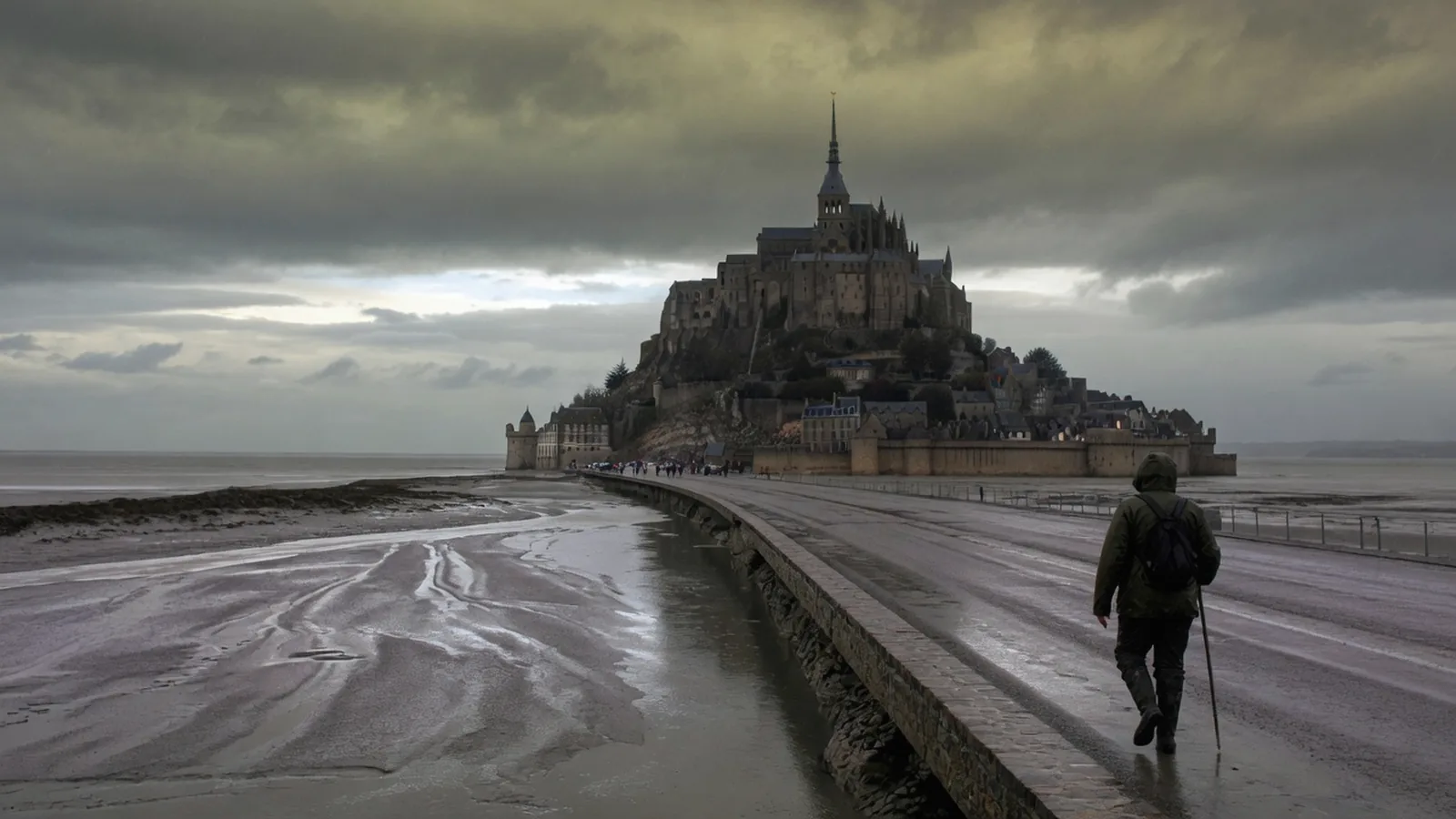
| Quick Facts | Detail |
|---|---|
| Location: Bay of Mont-Saint-Michel, Normandy (border with Brittany) | |
| Height: 92 metres from sea level to the tip of the archangel statue | |
| First monastery: 708 AD | |
| Abbey church: 11th–16th century (Romanesque + Gothic) | |
| UNESCO: World Heritage Site since 1979 | |
| Annual visitors: ~3 million | |
| Tides: Maximum tidal range 14 metres — among the highest in Europe | |
| Population: ~30 permanent residents |
Mont-Saint-Michel is the most dramatic sight in France. A granite island rising from vast tidal flats, crowned by a medieval abbey that seems to grow directly from the rock, surrounded by waters that advance and retreat across kilometres of sand at speeds that have drowned the unwary for centuries. On clear days, the silhouette — village, ramparts, buttresses, abbey, spire, and the gilded statue of the Archangel Michael at the summit — appears to float above the horizon like an apparition. It is architecture as miracle.
Origins & Legend
According to tradition, the Archangel Michael appeared to Aubert, Bishop of Avranches, in 708 AD, commanding him to build a church on the tidal rock then known as Mont-Tombe. Aubert ignored the vision twice; on the third occasion, the archangel allegedly burned a hole in the bishop's skull with his finger. Aubert complied. The skull, with its suggestive hole, is still displayed in the basilica of Avranches.
The first oratory was a simple grotto. Benedictine monks arrived in 966 under the patronage of the Duke of Normandy, and the great Romanesque abbey church was begun around 1017. The Merveille (The Marvel) — the three-storey monastic complex on the north face of the rock, built between 1204 and 1228 — is one of the supreme achievements of Gothic architecture: cloister, refectory, knights' hall, and the ethereal Salle des Hôtes, all stacked vertically and supported by buttresses of breathtaking engineering.
A Fortress Through the Ages
Mont-Saint-Michel's position made it a natural fortress. During the Hundred Years' War (1337–1453), it was the only place in Normandy that never fell to the English — despite repeated sieges and a blockade that lasted over two decades. A garrison of just 119 knights held the mount against thousands. The narrow Grand Rue, the fortified gates, and the steep terrain made assault virtually impossible. The English gave up and went home. The mount became a symbol of French resistance — a role reprised in World War II, when it was one of the first sites liberated after D-Day.
During the Revolution, the monks were expelled and the abbey was converted into a prison — the Mont-Libre (Free Mount) — where political prisoners were held in appalling conditions. Victor Hugo visited in 1836 and called it "a toad in a reliquary." His campaign for its preservation, alongside the restoration movement that saved Notre-Dame, eventually led to the prison's closure in 1863 and the abbey's classification as a monument historique (historic monument) in 1874.
The Tides
The bay of Mont-Saint-Michel has the highest tidal range in continental Europe — up to 14 metres between low and high water during spring tides. At low tide, the sea retreats as far as 15 kilometres from the mount, exposing vast expanses of sand and mudflats. At high tide, the water rushes in at extraordinary speed — famously described as advancing "at the speed of a galloping horse" (which is slightly exaggerated but not by much: the tide can cover ground at 6 km/h).
The tidal flats are genuinely dangerous. Quicksand-like patches of tangue (silty sand) can trap walkers, and the incoming tide can cut off retreat routes in minutes. Crossing the bay on foot is possible but must be done with a licensed guide. Since 2014, a new bridge-causeway has replaced the old road and parking lot that once blocked tidal flow, allowing the sea to circulate freely around the island again — restoring the maritime character that had been lost to siltation over the previous century.
Visiting Mont-Saint-Michel
- Getting there: From Paris — TGV to Rennes (1h 25m), then shuttle bus (1h 15m); or drive (3.5 hours via A13/A84)
- Parking: At the mainland car park (2.5 km from the mount); free shuttle buses or a scenic walk across the bridge-causeway
- Abbey tickets: €11 adults; free under 18 (EU residents) and under 26 (EU residents)
- Best time: Early morning (before 10 AM) or late afternoon (after 4 PM); twilight is magical
- Tides: Check the tide tables at ot-montsaintmichel.com — visiting at high tide (when the mount is surrounded by water) is the most dramatic experience
- Stay overnight: The village has a handful of small hotels; staying after the day-trippers leave transforms the experience
On the ground
| Pin | Working note |
|---|---|
| Page | Mont-Saint-Michel |
| Desk | L'Esprit |
| First use | Read the pins, then one related page — not five |
| Confirm | Official site or ticket desk the week you go |
The useful unit is one place or one question, not a fourteen-day montage of France. Mont-Saint-Michel sits in a country that is easy to over-plan and easy to under-prepare. The landmarks layer is where visitors collect names. This page is the opposite: what to do first, what to skip, and which sibling guide holds the rest.
France rewards a slow unit. One arrondissement, one valley, one appellation, one park trail. The photograph of five landmarks in five days is a real holiday, and it is also a queue with a passport. If you only have three nights, spend two of them in the same bed. The third night is for a train, not a third hotel.
Working a visit
Practical France is sockets (Type E/F, 230 V), tap water that is safe, pharmacies that are the real clinic for minor trouble, and a lunch hour that still closes a village. Cards work in cities. Cash still opens some park kiosks, some island boats, and some market stalls that have never seen contactless. A lightweight adapter belongs in the personal item, not the hold.
We will not write as if every reader is on a gap year, or as if every reader is in a palace hotel. We will not flatten 'the south' into one climate. We will not treat a strike day, a jour férié, or a Tuesday museum closure as a personality quirk of the French. They are calendars. Check them. Then use Mont-Saint-Michel as a pin, not as scripture.
Cross the five guides instead of cloning them. La Porte holds trains and the first week. La Terre holds weather and park gates. L'Esprit holds museum Tuesdays and the Revolution. La Table holds the market morning and the wine list. Le Moteur holds the Tour, the working week, and why August is empty in Paris and full on the coast.